
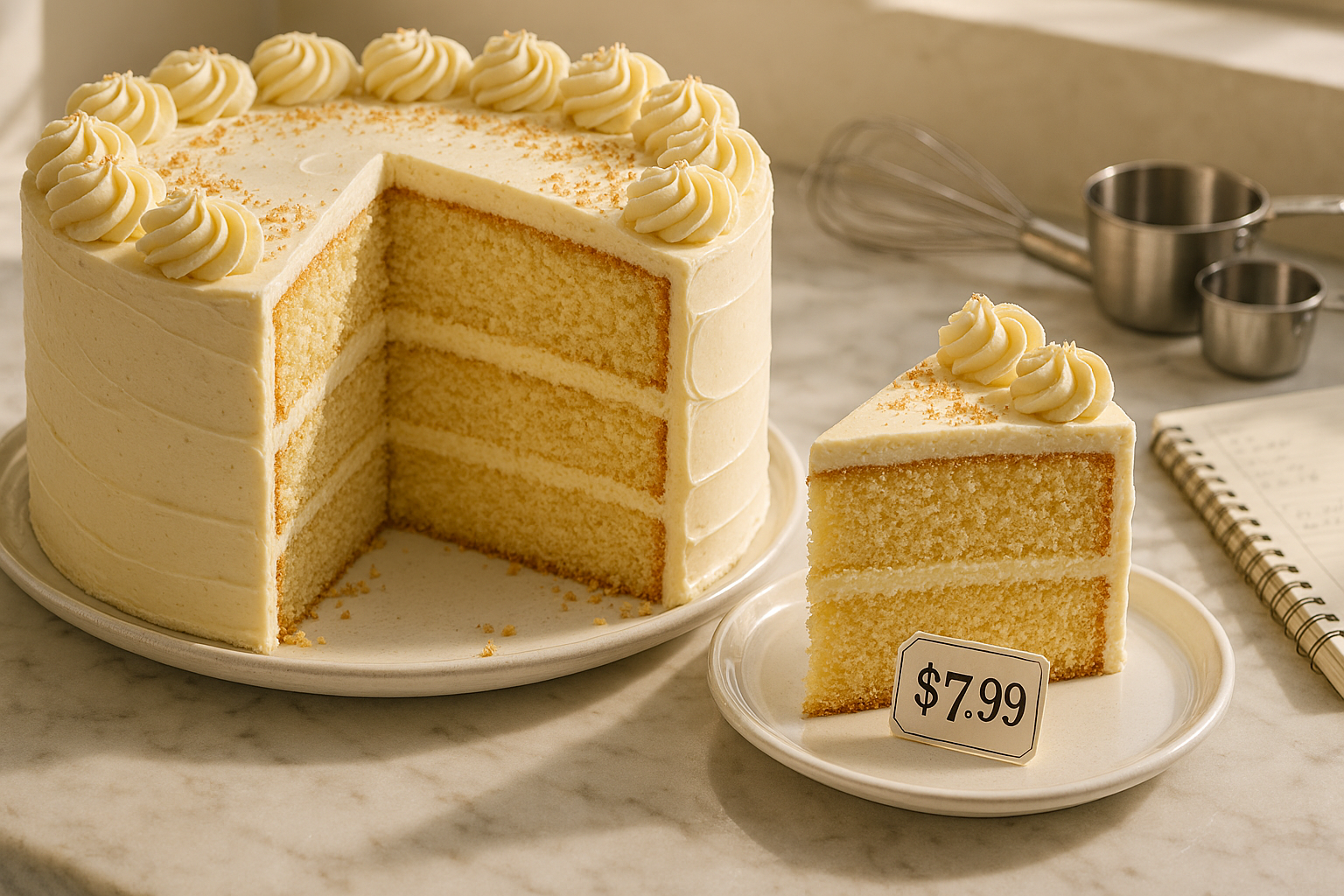
How Much to Charge for a Slice of Cake: The Baker's Complete Pricing Guide
Quick Answer: Wondering how much to charge for a slice of cake? Most home bakers should price slices between $7-8 using this proven formula: (Ingredients + Labor + Overhead) ÷ (1 - Profit Margin). Our free cake pricing calculator instantly does this math for you. Let's break down each component so you can price with confidence and profit.
Jump to Section:
The Real Cost of a Slice: It's More Than Just Flour and Sugar
Most bakers start by adding up ingredient costs. This is a critical first step, but it's only about 20-30% of the true story. To price correctly, you must account for four pillars:
- Ingredient Cost (Cost of Goods Sold - COGS): The flour, sugar, eggs, flavorings, and decorations.
- Labor Cost: Your time for baking, cooling, decorating, slicing, and packaging.
- Overhead (Fixed Costs): Rent, utilities, website, marketing, insurance, and equipment.
- Profit Margin: The money that keeps your business growing and rewards your risk.
Forgetting any of these is the #1 reason bakers end up feeling overworked and underpaid.
Step 1: Calculate Your Ingredient Cost Per Slice
This is your foundation. Let's break down a real example: a classic 8-inch vanilla layer cake that yields 12 generous slices.
| Ingredient Breakdown | Cost Per Slice | Common Mistake |
|---|---|---|
|
Flour, Sugar, Eggs: $3.50 Butter, Milk, Vanilla: $4.00 Frosting & Decor: $2.50 Total Ingredient Cost: $10.00 |
Total Cake Cost: $10.00 Number of Slices: 12 Ingredient Cost per Slice: $0.83 Base Cost |
If you charged only $2.00/slice based on this... You'd make only $1.17 to cover everything else. This is where profits disappear. |
Pro Tip: Tools like our Recipe Cost Calculator automate this math. Just input your recipe and package sizes—it calculates cost per gram and per serving instantly. For maximum savings, check our Bulk Buying Guide to reduce ingredient costs.
Accounting for "Hidden" Ingredient Costs
Don't forget the less obvious items that add up:
- Packaging: Cake box, slice container, napkin, sticker. This can add $0.25-$1.00 per slice.
- Utilities: The electricity for your oven and mixer. Estimate $0.10-$0.30 per cake.
- Failed Batches: A slight overbake or a broken layer. Allocate 5-10% of your ingredient cost for waste and testing.
Step 2: How to Value Your Time (Labor Cost)
Your skill and time are your most valuable assets. Never work for free.
Formula: (Your Hourly Rate) x (Hours Spent) ÷ Number of Slices
Example: You pay yourself a fair wage of $20/hour. The cake takes 2 hours active time (mixing, baking, decorating).
- Labor Cost for Cake: $20 x 2 hours = $40
- Labor Cost per Slice: $40 ÷ 12 slices = $3.33
Now, your slice cost is: $0.83 (ingredients) + $3.33 (labor) = $4.16. This is your break-even before overhead and profit. See how it changed the game?
Related: Want to improve your baking efficiency? See our guide on Equipment Efficiency to reduce labor time.
Step 3: Factoring in Overhead & Business Costs
Overhead is the cost of simply being in business. It's not tied to one cake but must be covered by all of them.
Monthly Overhead Might Include:
- Commercial Kitchen Rental: $300
- Website & Marketing: $100
- Insurance, Licenses, Software: $150
- Equipment Loan/Depreciation: $100
- Total Monthly Overhead: $650
If you sell 130 cakes (or ~1560 slices) per month, your overhead per slice is: $650 ÷ 1560 slices = $0.42 per slice.
Add this to our running total: $4.16 + $0.42 = $4.58 cost per slice.
The Final Step: Adding Your Well-Deserved Profit
Profit isn't a dirty word. It's what allows you to reinvest, grow, and weather slow months. A standard target is a 30-50% profit margin on your final selling price.
Let's apply a 40% profit margin to our final cost.
| Total Cost Per Slice | Final Price with 40% Profit |
|---|---|
|
Ingredients: $0.83 Labor: $3.33 Overhead: $0.42 Total Cost: $4.58 |
Formula: Cost ÷ (1 - Profit Margin) $4.58 ÷ (1 - 0.40) $4.58 ÷ 0.60 = $7.63 per slice Target Price |
So, how much to charge for a slice of cake in this scenario? A fair, profitable price lands around $7.50 - $8.00. This price respects your work, covers all costs, and builds a sustainable business.
How Market Prices Compare: Home Baker vs. Bakery vs. Café
Your local market sets the ceiling. Here's a typical range (for a premium slice, 2025):
- Home Baker / Cottage Food: $5 - $8 per slice. Competitive advantage is customization and artisan quality.
- Local Bakery: $7 - $12 per slice. Prices include retail space and staff.
- Specialty Café or High-End Restaurant: $10 - $16+ per slice. You're paying for ambiance, service, and brand.
Positioning is Key: Are you competing on price (budget-friendly) or value (premium ingredients, intricate designs)? Your answer guides your final number.
Your Exact Price: 3 Factors That Change Everything
1. Your Location's "Cake Economy"
Urban vs suburban vs rural changes acceptable prices. Research method: Check 3 local bakery menus. Average their slice price = your market ceiling.
2. Your Ingredient Tier
Generic vanilla vs Madagascar vanilla vs organic. Calculator tip: Input YOUR actual ingredient costs in our tool.
3. Your Customer's Expectations
Bake sale vs wedding vs café wholesale. Price adjustment: -20% for casual, +30% for premium events.
Stop Doing Math Manually
This is a lot of calculations to do for every cake variation. That's why we built a tool to do it for you. In our Recipe Cost & Pricing Calculator, you input your recipe, labor time, and overhead. It instantly shows your cost per slice and suggests a profitable retail price. It's the fastest way to go from recipe to confident price tag.
Try the Free Calculator NowFAQs: Quick Answers on Cake Slice Pricing
What is a standard cake slice size for pricing?
The industry standard for a "party slice" is about 2" x 4" (height varies). A standard 8-inch round cake yields 12-14 such slices. A 6-inch cake yields 6-8. Be consistent with your portioning, as size directly affects cost and customer perception.
What's the "3-2-1 Cake Pricing Rule" I've heard about?
It's an old caterer's rule: 3 times the ingredient cost. While simple, it's dangerously outdated. It ignores modern labor costs, digital marketing expenses, and today's competitive landscape. Using it often leads to severe underpricing.
How do I price for special diets (gluten-free, vegan)?
Specialty ingredients cost more. Calculate their exact cost (e.g., almond flour vs. wheat flour). Then, communicate the value: "Our gluten-free slices use premium almond flour, hence the $2 premium." Customers understand and pay for clear value.
Should I charge a cake cutting fee?
If you're providing a service (e.g., slicing and plating a whole cake at an event), a cutting fee of $1-$3 per slice is standard. This covers extra labor, plates, and staff. Always disclose this fee upfront.
How many slices in an 8-inch cake?
A standard 8-inch round cake yields 12-14 generous slices when cut using the party slice standard of 2" x 4". For wedding portions, you can get 24-30 smaller slices. For precise measurements, use our calculator tool.
What's the average profit margin for cake slices?
A healthy profit margin for cake slices is 30-50% on the final selling price. For home bakers, 40% is a good target. This accounts for all costs while remaining competitive. Learn more about pricing strategy in our How it Works guide.
How much to charge for a slice of cake at a bake sale?
Bake sale pricing is different: $3-5 per slice. Lower because it's casual, volume-based, and customers expect deals. Pro tip: Offer "2 slices for $7" to increase sales.
Should I charge differently for different cake flavors?
Yes! Chocolate ($6-8) vs. Red Velvet ($8-10) vs. Specialty ($10-12). Complexity and ingredient costs justify price tiers. Never charge the same for simple vs complex.
How to respond when customers say "That's too expensive"?
Have a value script: "Our $8 slice uses real Madagascar vanilla ($25/bottle) and takes 3 hours handmade time. Comparable bakery slices cost $10-12. You're getting artisan quality at home-baker prices."
Psychological Pricing Tricks That Work
Once you have your cost-based price, consider these tweaks:
- $7.99 vs. $8.00: The "left-digit effect" makes $7.99 feel closer to $7 than $8.
- Bundle a Slice & Coffee: Offer a "Coffee Break Combo" for $10.50 instead of $8 + $3.50 separately. It increases order value.
- Highlight Your "Hero Ingredient": "Featuring single-origin Vanilla from Madagascar" justifies a higher price point by focusing on quality.
Sources & Further Learning: Pricing formulas are based on restaurant industry cost-control standards and small business administration guidelines. Market price data is aggregated from publicly available menus and bakery listings. For deeper dives into food cost percentage, see our How it Works page.
From Confusion to Confidence
Knowing how much to charge for a slice of cake transforms your baking from a stressful hobby into a rewarding, profitable venture. You're not just selling dessert; you're selling your expertise, time, and creativity. Price it like the valuable offering it is.
Stop guessing and start calculating with precision. Use the formulas in this guide, or better yet, let our dedicated tool handle the complex math instantly.
Calculate Your Perfect Price Now →Explore our full suite of Baking Tips to master the business of baking. Next, check out how to reduce ingredient costs or learn about proper measurement techniques.