
1 Cup to Grams? The Baker's Complete Conversion Guide
Jump to Section:
Why Professional Bakers Use Grams (And You Should Too)
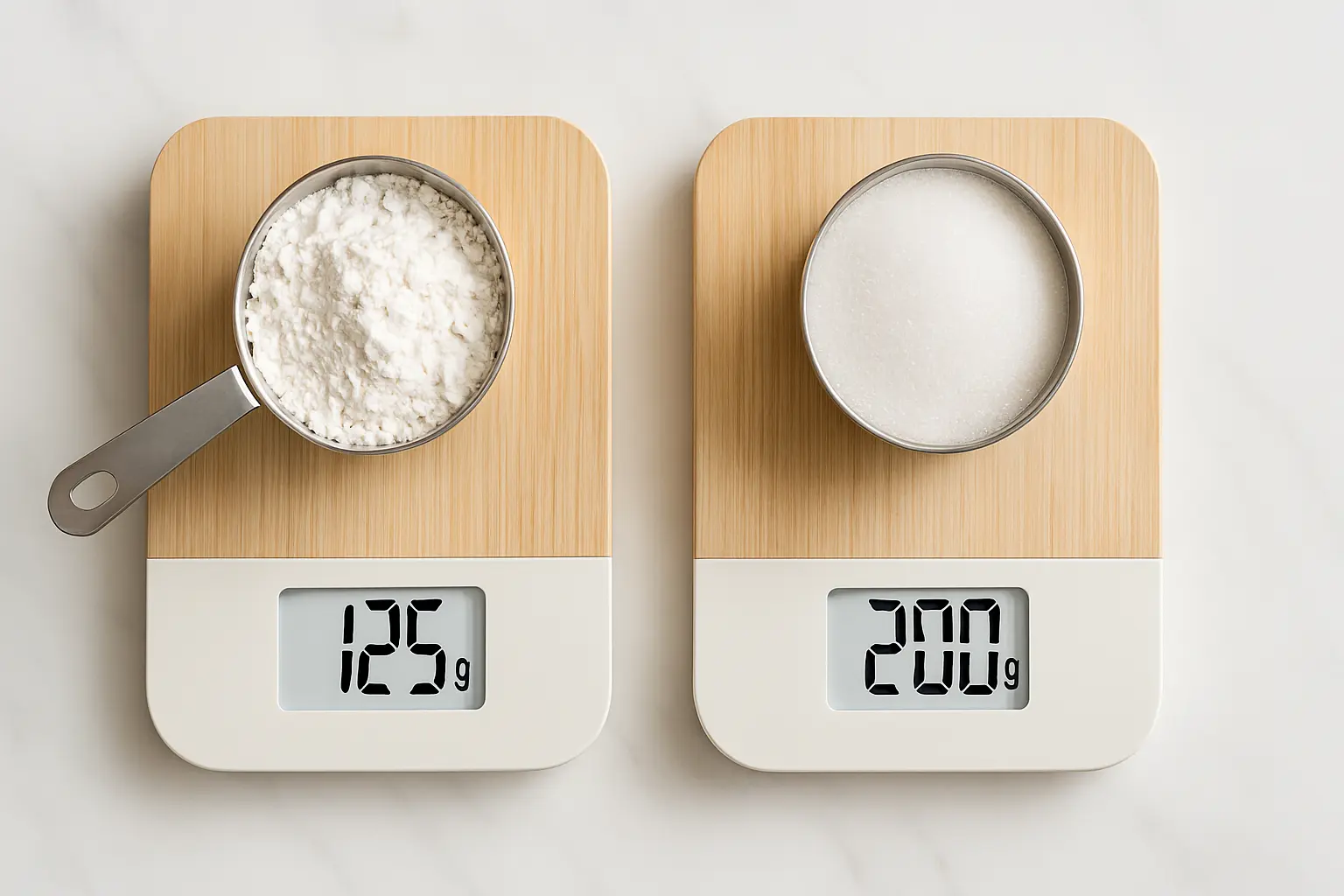
Here's the uncomfortable truth: 1 cup is not a precise measurement. It's a volume measurement that varies wildly based on how you fill it. Meanwhile, 125 grams is always 125 grams.
- The "Flour Fiasco": 1 cup of flour can weigh anywhere from 100g (sifted and spooned) to 145g (scooped from the bag). That's a 45% variation!
- The "Sugar Surprise": Brown sugar varies even more: 1 cup packed = 220g, 1 cup loose = 145g. Recipes rarely specify which they mean.
- The Real Cost: Inconsistent measurements lead to failed cakes, dense breads, and wasted ingredients. Professional bakeries can't afford this variability.
- The Solution: A $20 kitchen scale gives you professional-grade precision. It's the single best investment for better baking.
Still not convinced? Try this: Measure 1 cup of flour your usual way, then weigh it. Tomorrow, measure another cup and weigh it again. Bet they're different.
The Essential Cup-to-Gram Conversion Chart (Based on USDA & King Arthur Data)
These values come from our comprehensive database that combines USDA government data with King Arthur Baking Company professional standards. Want to see our sources? Check our methodology page for complete transparency.
| Ingredient | 1 Cup (US) in Grams | Notes & Variation | Data Source |
|---|---|---|---|
| All-purpose flour | 125g | USDA standard. King Arthur uses 120g. Scooped: 145g | USDA + King Arthur |
| Bread flour | 127g | Slightly denser than AP flour | King Arthur Standard |
| Cake flour | 120g | Finer texture, lighter weight | USDA + King Arthur |
| Granulated sugar | 200g | Most consistent dry ingredient | USDA Standard |
| Brown sugar (packed) | 220g | Must be firmly packed into cup | USDA Standard |
| Powdered sugar | 115g | Sifted: 100g, Unsifted: 125g | USDA Standard |
| Butter | 227g | Exactly 2 sticks or 8 oz | USDA Standard |
| Water/Milk | 240g | Liquid ounces = weight ounces | USDA Standard |
| Honey/Syrup | 340g | Varies by type: 320-360g range | USDA Standard |
| Rolled oats | 85g | Varies by brand and flake size | USDA Standard |
All conversion data sourced from the USDA SR Legacy Database and King Arthur Baking Company standards . See our methodology page for complete citations.
Pro Tip: Our Baking Conversion Calculator has 200+ ingredients with these precise conversions built in. Just select your ingredient and quantity - it handles the math instantly. No memorization required!
The Hidden Variables That Change Everything
Even with these standards, real-world factors affect your measurements:
- Humidity: Flour absorbs moisture from the air. On humid days, 1 cup can weigh 5-10g more.
- Settling: Flour settles in storage. A freshly opened bag vs. one that's been sitting for months can differ.
- Brand Variations: Different brands mill flour to different fineness levels.
- Measuring Technique: The "dip and sweep" method adds 15-20% more flour than "spoon and level."
The Science: How Our Calculator Converts Cups to Grams
Ever wonder how we calculate these conversions? It's all about density - the mass of a substance per unit volume. Our system, explained in our methodology, works like this:
1. The Density Database (USDA + King Arthur)
We maintain a database of ingredient densities (grams per milliliter) derived from:
- USDA SR Legacy Database: Government data for 8,000+ foods
- King Arthur Baking Company: Professional baking standards
Example: All-purpose flour density = 0.528 g/ml
2. The Conversion Math
Formula: grams = cups × 236.588 × density
Where 236.588 ml = 1 US cup
For flour: 1 cup × 236.588 ml × 0.528 g/ml = 125g
3. Real-World Adjustments
We apply baking-specific corrections from King Arthur standards:
- Flour: Adjusted for typical "spoon and level" technique
- Sugar: Separate values for granulated, powdered, brown
- Liquids: Temperature corrections for oils and syrups
Related: Curious about the technical details? See exactly how our density database works with complete source citations.
4 Cup Measurement Mistakes That Ruin Baking (And How to Fix Them)
| Common Mistake | What Happens | The Gram Solution |
|---|---|---|
|
Scooping flour from the bag Packs flour into cup, adding 15-20% extra |
Dense, dry baked goods Cookies don't spread, cakes are tough |
125g flour is always 125g No packing variation Fixed! |
|
Not packing brown sugar Using loose sugar when recipe expects packed |
Less sweetness, drier texture Missing moisture content |
220g brown sugar Exactly right regardless of packing Fixed! |
|
Using liquid measuring cups for dry ingredients Can't level properly, inaccurate readings |
Consistent measurement errors Recipe fails despite "following directions" |
Grams work for both One scale handles everything Fixed! |
|
Guessing on sticky ingredients Honey, syrup, peanut butter stuck in cup |
Incorrect amounts, messy cleanup Wasted ingredients left in cup |
Weigh directly in mixing bowl No sticky cups to clean Fixed! |
The pattern is clear: Every cup measurement problem disappears when you use grams. That's why professional kitchens have scales at every workstation.
Professional Baking Tips: Beyond Simple Conversions
Converting cups to grams is just the beginning. Here's what the pros really do:
The "Baker's Percentage" Method
Professional bakers express every ingredient as a percentage of the flour weight. Example bread recipe:
- Flour: 500g (100%)
- Water: 350g (70%)
- Salt: 10g (2%)
- Yeast: 5g (1%)
Manual Calculation: Use our calculator to get ingredient weights, then calculate percentages manually: (Ingredient weight ÷ Flour weight) × 100 = Percentage
Note: Future update will include automated baker's percentage calculations!
Weight-Based Recipe Development
When creating new recipes, start with weights from day one:
- Record everything in grams during testing
- Convert to cups only for publication (if needed)
- Provide both measurements for different audiences
This is how cookbooks like King Arthur Baking Companion maintain consistency.
The "Tare" Button is Your Best Friend
Kitchen scales have a "tare" or "zero" button. Use it:
- Place mixing bowl on scale
- Press "tare" (resets to 0)
- Add flour until scale reads 125g
- Press "tare" again (back to 0)
- Add sugar until 200g
- Repeat for all ingredients
One bowl, no measuring cups to wash!
Stop Memorizing Conversion Charts
You don't need to remember that 1 cup of almond flour is 96g or that 1 cup of honey is 340g. That's why we built a tool that knows all the conversions instantly. Our Baking Conversion Calculator has the complete USDA and King Arthur database built in. Select any of 200+ ingredients, choose cups or grams, and get perfect conversions every time.
Try the Free Calculator NowFAQs: Your Cup-to-Gram Questions Answered
How many grams is 1 cup of all-purpose flour?
1 cup of all-purpose flour = 125 grams when spooned into the cup and leveled. This is based on USDA data and King Arthur Baking Company standards. Note: If you scoop flour directly from the bag, you'll get about 145g - that's why weighing is more accurate.
Why does 1 cup weigh different amounts for different ingredients?
Different ingredients have different densities (mass per volume). Think of 1 cup of feathers vs 1 cup of rocks - same volume, vastly different weight! In baking: sugar crystals are denser than flour particles, butter is denser than oil. Our calculator uses USDA density data (grams per milliliter) for precise conversions.
Is 1 cup of flour always 125 grams?
While 125g is the USDA/King Arthur standard, real-world variation exists: Spooned flour = ~120g, Scooped flour = ~145g, Sifted flour = ~100g. Humidity can add another 5-10g. For consistent baking, we recommend using a kitchen scale and standardizing your technique.
Where does PastryCal's conversion data come from?
Our data combines USDA government databases (scientific accuracy for 8,000+ foods) with King Arthur Baking Company professional standards. See our methodology page for complete source citations and transparency about how we calculate each conversion.
How many grams is 1 cup of brown sugar?
Brown sugar varies dramatically by packing: 1 cup packed brown sugar = 220g, 1 cup loose brown sugar = 145g. In recipes, "packed" usually means pressing the sugar firmly into the cup until no air pockets remain. When in doubt, use our calculator which includes both options.
Should I use cups or grams for baking?
Professional bakers use grams for consistency. Cups can vary by 20% due to scooping technique, humidity, and settling. Grams are precise, reproducible, and eliminate guesswork. Even King Arthur Baking recommends weighing for best results. A basic kitchen scale costs less than a cookbook but improves your baking more than any other tool.
How do I convert a recipe from cups to grams?
Three methods: 1) Use our calculator for each ingredient, 2) Reference our conversion chart above, or 3) For flour, multiply cups by 125; for sugar, multiply by 200; for liquids, multiply by 240. Write the grams in your recipe book once - you'll never need to convert again!
Are metric cups (250ml) different from US cups (240ml)?
Yes! This causes international confusion. 1 US cup = 240ml, 1 metric cup = 250ml. That's a 10ml difference per cup! Most online recipes use US cups. Our calculator uses US standard (236.588ml technically) unless you select otherwise. Always check which standard a recipe uses.
What's the most accurate way to measure 1 cup of flour?
For those still using cups: 1) Fluff flour in bag with fork, 2) Spoon gently into cup, 3) Level with straight edge, 4) Never tap or shake the cup. Better yet: Place bowl on scale, tare to zero, add flour until scale reads 125g. This is foolproof.
The Real Cost of Cup Measurements
Think cup measurements are "close enough"? Consider this:
- Failed batches: One mis-measured cup can ruin $10 of ingredients
- Inconsistent results: Your famous cookies taste different every time
- Recipe scaling problems: Doubling a cup-based recipe often fails
- Time wasted: Washing multiple measuring cups vs one bowl
A $20 kitchen scale pays for itself in 2-3 successful batches instead of failures.
Sources & Further Learning: Conversion data from USDA SR Legacy Database and King Arthur Baking Company Ingredient Weight Chart. Professional baking standards based on CIA (Culinary Institute of America) baking textbooks and professional bakery interviews. For technical details on density calculations, see our How it Works page.
From Guesswork to Precision
Knowing how many grams is 1 cup transforms your baking from inconsistent to professional-grade. You're not just converting measurements; you're embracing the precision that separates good bakers from great ones.
Stop wondering and start weighing with confidence. Use the conversions in this guide, or better yet, let our tool handle the complex database of 200+ ingredient densities instantly.
Convert Cups to Grams NowExplore our full suite of Baking Tips to master professional baking techniques. Next, check out measurement accuracy techniques or learn about scaling recipes professionally.