
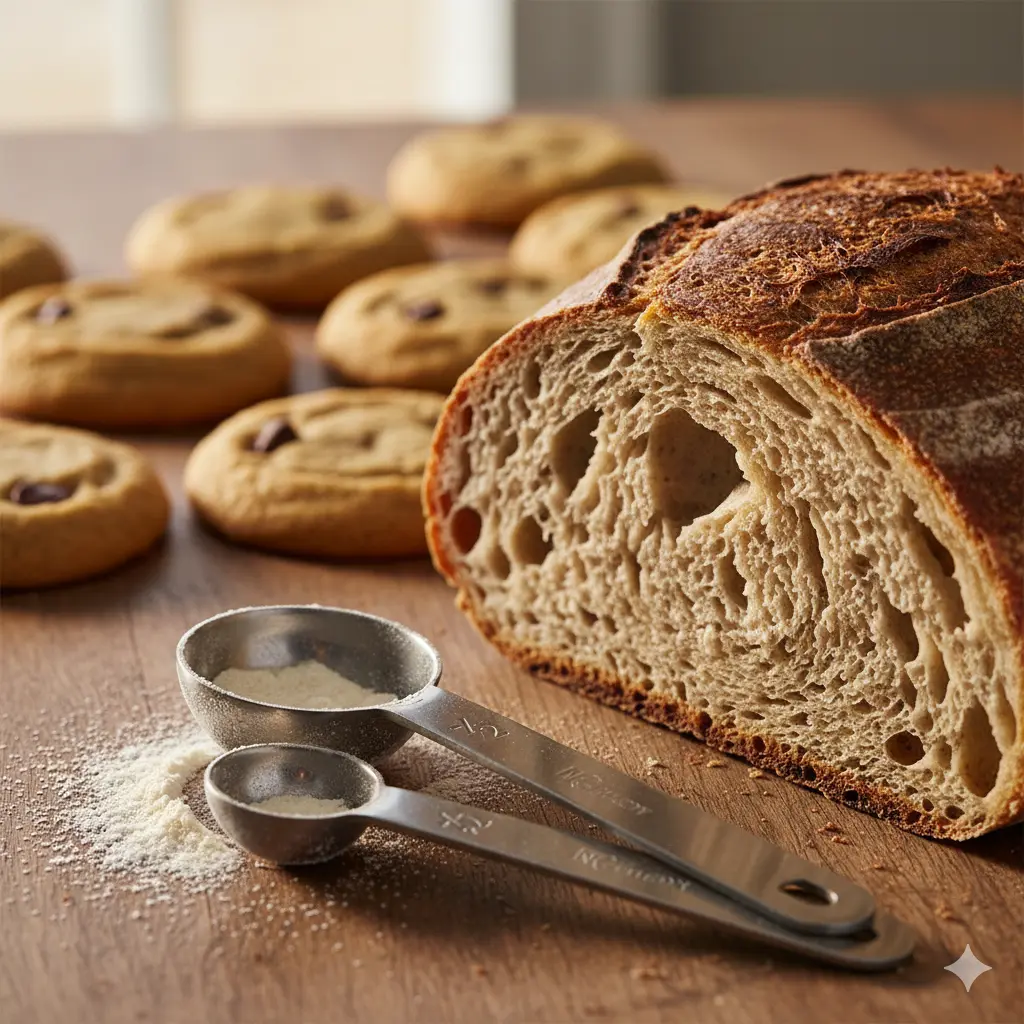
How to Scale a Recipe: The Complete 2025 Guide with Calculator
Quick Answer
Scaling a recipe requires more than simple multiplication. While flour, sugar, and liquids scale linearly (1:1), baking powder follows the 1.5x rule when doubling to prevent collapse. Salt and spices also use 1.5x due to diminishing returns in taste perception. Always use weight measurements (grams) and adjust baking time by 25% for same-depth pans.
🎯 Interactive Recipe Scaling Calculator
Scale any recipe with scientific adjustments for leaveners and spices
| Ingredient | Amount | Unit | Action |
|---|
Scaled Recipe Results
| Ingredient | Original | Scaled | Baker's % | Notes |
|---|
Jump to Section:
What Does "Scaling a Recipe" Mean?
Scaling a recipe means adjusting ingredient quantities to make more or less than the original recipe yields. While this sounds simple, baking recipes involve complex chemical reactions that don't always scale linearly.
When you scale a recipe up (increase yield), you're not just making more food—you're changing the physics of heat transfer, the chemistry of leavening, and the geometry of your baking vessel. Similarly, scaling a recipe down (decreasing yield) presents its own challenges with mixing dynamics and heat loss.
Professional vs. Home Baking Scaling
Professional bakeries use Baker's Percentage method where flour is always 100% and other ingredients are percentages of that weight. This system makes scaling foolproof. Our calculator above automates this professional approach.
How to Scale a Recipe: 5-Step Process
Step 1: Convert to Weight Measurements
Volume measurements (cups) are unreliable for scaling. One cup of flour can weigh anywhere from 100g (sifted) to 145g (scooped). Use a digital kitchen scale and convert everything to grams before scaling.
Step 2: Calculate Your Scaling Factor
Formula: Scaling Factor = Desired Yield ÷ Original Yield
Example: To double a recipe that serves 8 to serve 16: 16 ÷ 8 = 2.0 (doubling)
Our calculator above automates this calculation and shows your scaling factor in real-time.
Step 3: Apply Linear Scaling to Structural Ingredients
Multiply these by your scaling factor (1:1 ratio):
- Flour (provides structure)
- Sugar (sweetness, tenderness, browning)
- Liquids (water, milk, eggs for hydration)
- Fats (butter, oil for tenderness)
Step 4: Apply Non-Linear Adjustments
The 1.5x Rule: When doubling (2x), multiply these by 1.5 instead of 2:
- Baking powder & baking soda (prevent structural collapse)
- Salt & spices (account for diminishing taste returns)
Step 5: Adjust Baking Time and Temperature
If using same pan depth: Increase baking time by 25%
If batter is deeper: Reduce temperature by 25°F and increase time significantly
Linear vs. Non-Linear Scaling: The Critical Difference
| Ingredient Type | Scaling Rule | When Doubling | Scientific Reason |
|---|---|---|---|
| Structural Ingredients (Flour, Sugar, Liquid) |
Linear (1:1) | Multiply by 2.0 | Provides physical matrix; scales proportionally |
| Chemical Leaveners (Baking Powder, Soda) |
Non-Linear | Multiply by 1.5 | Prevents gas saturation and structural collapse |
| Flavor Agents (Salt, Spices, Extracts) |
Non-Linear | Multiply by 1.5 | Diminishing returns in taste perception |
| Baking Time | Non-Linear | Increase by 25% | Heat conduction follows surface area:volume ratio |
Key Insight: Most recipe scaling failures happen because bakers assume everything scales linearly. Professional bakers know that leaveners, spices, and baking time require non-linear adjustments.
The Chemistry: Why Baking Powder Doesn't Double
The 1.5x Rule Explained
When you scale a recipe up and double the baking powder (2x), you produce double the carbon dioxide gas. However, the gluten and protein structure can't always handle double the internal pressure. The bubbles rupture, and the cake collapses.
Saturation Point: Each batter has a maximum gas-holding capacity. Exceeding this causes structural failure. The 1.5x multiplier keeps gas production within safe limits while still providing adequate lift.
Scaling Leaveners: Exact Rules
- Doubling recipe (2x): Multiply baking powder by 1.5
- Tripling recipe (3x): Multiply baking powder by 2.0
- Halving recipe (0.5x): Multiply baking powder by 0.6
- Quartering recipe (0.25x): Multiply baking powder by 0.35
Yeast is Different
Yeast scales linearly by weight, but fermentation time changes. Larger dough batches retain heat better and ferment faster. You may need cooler water or shorter proofing times when scaling yeast doughs up.
Flavor Science: The Law of Diminishing Returns
Your tongue doesn't perceive flavors linearly. Doubling salt (2x) doesn't make food taste twice as salty—it makes it taste overwhelmingly salty. This is the law of diminishing returns in sensory perception.
Surface Area to Volume Ratio in Flavor
When you scale a recipe up, the ratio of crust (flavorful surface) to interior crumb decreases. A large cake has relatively less crust per volume than a small cake. This affects how salt and spices are perceived throughout the bite.
Practical Flavor Scaling Rules
- Salt: Multiply by 1.5 when doubling, then adjust to taste
- Spices: Multiply by 1.5 when doubling, then adjust
- Extracts: Multiply by 1.5 when doubling
- Acids (lemon juice, vinegar): Multiply by 1.75 when doubling
Taste Test Tip: Always reserve 10% of scaled seasonings. Mix everything, taste, then add remaining seasonings if needed. You can add more but can't remove excess.
Baking Physics: Time and Temperature Adjustments
The Surface Area to Volume Problem
When you scale a recipe up, volume increases faster than surface area. Heat enters through the surface and conducts inward. Deeper batter means heat must travel farther to reach the center.
Two Scaling Scenarios:
Scenario 1: Same Pan, More Pans
If you bake a double batch in two identical pans (same depth):
- Baking time: Increase by 25%
- Temperature: Keep same
- Example: Original 30 min becomes 38 min
Scenario 2: Larger Pan, Deeper Batter
If you bake a double batch in one larger pan (deeper batter):
- Baking time: Increase by 50-100%
- Temperature: Reduce by 25°F (14°C)
- Example: 350°F for 30 min becomes 325°F for 45-60 min
The Toothpick Test Still Applies
No matter what calculations you use, always test for doneness. Insert a toothpick into the center—it should come out clean with just a few moist crumbs. For large cakes, test multiple spots.
5 Common Recipe Scaling Mistakes (And How to Avoid Them)
| Mistake | Result | Solution |
|---|---|---|
| Doubling baking powder (using 2x instead of 1.5x) |
Collapsed cake with coarse texture | Use 1.5x rule for leaveners |
| Using volume measurements (cups instead of grams) |
Inconsistent results batch to batch | Weigh ingredients with digital scale |
| Not adjusting baking time (baking doubled batch same time) |
Raw center, burned edges | Increase time 25% for same depth |
| Over-mixing small batches (using same mixer speed/time) |
Tough, dense texture | Mix less, use lower speed |
| Doubling all spices (ignoring diminishing returns) |
Overpowering, unbalanced flavor | Use 1.5x rule, then adjust to taste |
FAQs: Recipe Scaling Questions Answered
What does scaling a recipe mean?
Scaling a recipe means adjusting ingredient quantities to make more (scaling up) or less (scaling down) than the original recipe yields. In baking, this requires understanding both linear scaling for structural ingredients and non-linear scaling for leaveners, spices, and baking time.
What is the formula for adjusting recipes?
The basic formula is: Scaling Factor = Desired Servings ÷ Original Servings. Multiply ingredient amounts by this factor. However, for baking, you must modify this: use 1.5x (not 2x) for leaveners and spices when doubling, and increase baking time by 25% for same-depth pans.
What is scaling in a bakery?
In professional bakeries, scaling refers to measuring ingredients by weight (usually grams) using the Baker's Percentage system. Flour is always 100%, and other ingredients are percentages of the flour weight. This system makes scaling any size batch simple and precise.
What is a scale in cooking?
A scale in cooking has two meanings: 1) A kitchen scale for weighing ingredients, and 2) The process of adjusting recipe quantities. Professional chefs use digital scales for accuracy, as weight measurements don't vary like volume measurements (cups).
How do I double baking powder when scaling a recipe?
Do not simply double baking powder. When doubling a recipe (2x), multiply baking powder by 1.5 instead of 2. This prevents excessive gas production that can collapse the cake structure. Our calculator above applies this rule automatically.
Does baking time change when scaling a recipe?
Yes, significantly. If using the same pan depth (more pans), increase baking time by 25%. If batter is deeper (larger pan), reduce temperature by 25°F and increase baking time by 50-100%. Always test for doneness with a toothpick.
Why do my doubled recipes taste too salty?
Because taste perception follows the law of diminishing returns. Doubling salt (2x) overwhelms the palate. Multiply salt by 1.5 when doubling, then adjust to taste. The same applies to spices and extracts.
Can I scale a recipe without a kitchen scale?
Not accurately. Volume measurements (cups) vary too much for reliable scaling. A $20 digital scale is essential for proper recipe scaling. If you must use cups, fluff flour before spooning into cup and leveling—but expect inconsistency.
Stop Guessing, Start Scaling Accurately
Our recipe scaling calculator above handles all the complex math: linear scaling for flour/sugar/liquids, 1.5x rule for leaveners and spices, Baker's percentages, and baking time adjustments. Enter your recipe once and scale to any size perfectly.
Try it now: Load the example recipe in the calculator to see how professional scaling works.
Master Recipe Scaling Today
Scaling a recipe transforms you from a recipe follower to a recipe master. By understanding the science behind linear vs. non-linear scaling, the chemistry of leaveners, and the physics of baking, you can confidently adjust any recipe to feed any crowd.
Bookmark this page and our calculator for your next baking project. Share it with fellow bakers who struggle with doubled recipes that fail.
Use the Recipe Scaling Calculator →Explore more Baking Tips or learn about cup to gram conversions for precise measurements.