
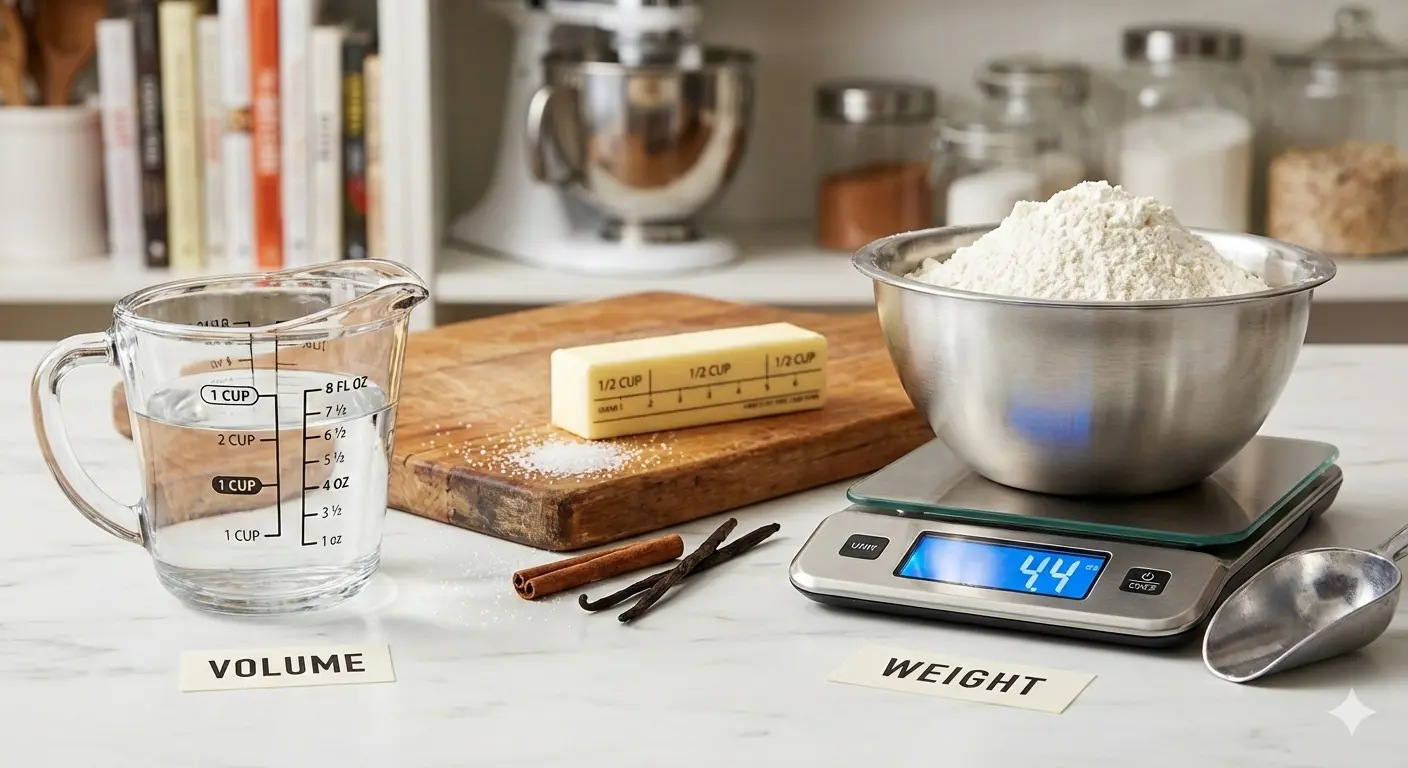
How Many Ounces in a Cup? The Fluid vs Weight Ounce Dilemma Solved
Jump to Section:
The Critical Difference: Fluid Ounces (Volume) vs Weight Ounces (Mass)
This is the most important concept in culinary measurement: Fluid ounces measure volume, weight ounces measure mass. They are different measurement systems with different historical origins.
- Fluid Ounce (fl oz): Measures volume. 1 US fluid ounce = 29.57 mL. Derived from the wine gallon (231 cubic inches). Used for liquids.
- Weight Ounce (oz): Measures mass. 1 avoirdupois ounce = 28.35 grams. Derived from the Roman "uncia" (one-twelfth of a pound). Used for dry ingredients.
- The Water Exception: 1 fluid ounce of water weighs approximately 1.04 weight ounces at room temperature. This approximate 1:1 ratio causes confusion.
- The Butter Anomaly: Butter is the only common ingredient where 1 cup volume = 8 ounces weight exactly. This is because butter's density happens to align perfectly.
When a recipe says "8 ounces of flour" it means weight ounces. When it says "8 ounces of milk" it usually means fluid ounces. But many recipes are ambiguous - that's where our converter solves the problem.
The Complete Cup-to-Ounce Conversion Chart (USDA & NIST Data)
These values combine USDA density data with NIST volume standards for precision. All values are for US customary cups (236.6 mL).
| Ingredient | 1 Cup (US) in Fluid Ounces | 1 Cup (US) in Weight Ounces | Notes |
|---|---|---|---|
| Water, Milk, Juice | 8.0 fl oz | ~8.3 oz | Volume:fluid ounce exact; Weight varies slightly |
| All-purpose flour | N/A (dry) | 4.4 oz | USDA standard (spoon & level method) |
| Bread flour | N/A | 4.5 oz | Slightly denser than AP flour |
| Granulated sugar | N/A | 7.1 oz | USDA Standard |
| Brown sugar (packed) | N/A | 7.8 oz | Must be firmly packed |
| Powdered sugar | N/A | 4.1 oz | Sifted: 3.5 oz, Unsifted: 4.4 oz |
| Butter | 8.0 fl oz | 8.0 oz | Unique 1:1 volume:weight ratio |
| Vegetable oil | 8.0 fl oz | ~7.7 oz | Lighter than water (0.92 g/mL) |
| Honey, Syrup | 8.0 fl oz | ~11.9 oz | Much denser than water (1.42 g/mL) |
| Rolled oats | N/A | 3.0 oz | Varies by brand and flake size |
Volume data sourced from NIST Weights and Measures Division. Weight data from USDA SR Legacy Database. See our methodology page for complete citations.
Pro Tip: Our Baking Conversion Calculator instantly converts between cups, fluid ounces, and weight ounces for 200+ ingredients. No memorization needed!
Why Butter is the Only 1:1 Ingredient
Butter has a density of approximately 0.959 g/mL. The math works perfectly:
- 1 US cup = 236.6 mL
- 236.6 mL × 0.959 g/mL = 227 grams
- 227 grams ÷ 28.35 g/oz = 8.0 ounces
This perfect alignment is why butter is often measured by weight in professional kitchens but works reliably by volume in home baking.
Global Cup Standards: US vs Imperial vs Metric
The "cup" varies dramatically by country. Using the wrong standard can ruin recipes:
| Country/System | Cup Volume | Fluid Ounces per Cup | Used In |
|---|---|---|---|
| US Customary | 236.6 mL | 8.0 US fl oz | Most US recipes, cookbooks |
| US Legal (FDA) | 240.0 mL | 8.12 US fl oz | Nutrition labels, commercial packaging |
| Metric Cup | 250.0 mL | 8.45 US fl oz | Australia, Canada, NZ, South Africa |
| Imperial Cup (UK) | 284.1 mL | 9.61 US fl oz | Older UK recipes (pre-metric) |
| Japanese Cup | 200.0 mL | 6.76 US fl oz | Japan (except rice: 180 mL) |
Critical: A 5.6% difference (US to Metric) seems small but adds up. In a cake needing 3 cups flour, using a Metric cup adds an extra 40 mL flour = drier cake. Always check recipe origin!
4 Common Ounce Measurement Mistakes That Ruin Recipes
| Mistake | What Happens | The Solution |
|---|---|---|
|
Confusing fluid oz with weight oz Using liquid measuring cup for flour "ounces" |
Recipe uses 50% less flour than intended Runny batter, failed structure |
Use scale for dry ingredients Weigh flour: 4.4 oz per cup Fixed! |
|
Using Imperial fluid ounces for US recipe 1 Imperial fl oz = 0.96 US fl oz |
4% less liquid than recipe intended Dry baked goods, altered hydration |
Use US measuring tools Or convert: multiply US fl oz by 1.04 Fixed! |
|
Not packing brown sugar properly Loose vs packed varies by 40% |
Missing moisture and sweetness Dry cookies, flat flavor |
Weight ounces don't vary 7.8 oz packed brown sugar = always correct Fixed! |
|
Assuming all liquids weigh 8 oz per cup Honey weighs 11.9 oz per cup |
Heavy syrups sink, uneven distribution Overly sweet, dense results |
Use our converter for each liquid Account for different densities Fixed! |
Professional Baking Tips: Mastering Ounce Measurements
The "Two-Scale" Solution for Professional Kitchens
Serious bakers use two scales:
- Precision scale: 0.1g resolution for yeast, salt, baking powder
- Production scale: 1g resolution for flour, sugar, liquids
This eliminates all volume measurements and guarantees consistency.
How to Convert Any Recipe from Cups to Ounces
Three-step process:
- Identify each ingredient as liquid (use fluid ounces) or dry (use weight ounces)
- Use our converter or USDA chart for conversion factors
- Write the ounces next to cups in your recipe book
Once converted, you'll never need to convert again for that recipe.
The "Ounce Test" for Recipe Quality
Professional bakers judge recipes by whether they provide:
- Weight measurements (ounces or grams)
- Clear specification: "8 oz flour" vs "8 fl oz milk"
- Packing instructions for brown sugar
Recipes with only volume measurements are 3x more likely to fail when scaled.
Stop Guessing Ounce Conversions
You don't need to remember that 1 cup of honey weighs 11.9 ounces or that 1 cup of flour is 4.4 ounces. Our Baking Conversion Calculator has the complete USDA and NIST database built in. Convert between cups, fluid ounces, and weight ounces instantly for 200+ ingredients.
FAQs: Your Ounce and Cup Questions Answered
How many ounces are in 1 cup?
For liquids: 1 US cup = 8 fluid ounces exactly. For dry ingredients: It varies by density: all-purpose flour = 4.4 oz, granulated sugar = 7.1 oz, butter = 8 oz. Use our converter for precise ingredient-specific conversions.
Is 8 oz the same as 1 cup?
Yes for liquid volume (8 fluid ounces = 1 cup) and for butter (8 weight ounces = 1 cup). No for most dry ingredients: 8 oz of flour is about 1.8 cups, 8 oz of sugar is about 1.1 cups. The confusion comes from butter's unique 1:1 ratio.
How many ounces in a cup of flour?
1 cup of all-purpose flour weighs approximately 4.4 ounces (125 grams). Variations: sifted flour = 3.9 oz, scooped flour = 5.1 oz. Weight ounces eliminate this variation.
How many fluid ounces in a cup?
1 US customary cup = 8 US fluid ounces (236.6 mL). The US legal cup (for nutrition labels) = 8.12 fl oz (240 mL). Metric cup (Australia/Canada) = 8.45 fl oz (250 mL). Always check which standard your recipe uses.
Why are fluid ounces and weight ounces different?
They're different measurement systems. Fluid ounces measure volume (space), weight ounces measure mass (quantity). They coincidentally align for water (approximately 1:1) but diverge for other ingredients. Honey is 1.5x denser than water, so 1 fl oz honey weighs 1.5 oz.
How do I convert cups to ounces for baking?
Three methods: 1) Use our converter, 2) Reference USDA chart above, 3) For liquids: cups × 8 = fluid ounces; For dry: cups × ingredient-specific factor (flour: ×4.4, sugar: ×7.1). We recommend method 1 for accuracy.
Are metric cups different from US cups?
Yes! 1 metric cup = 250 mL (8.45 US fl oz), 1 US cup = 236.6 mL (8.0 US fl oz). That's a 13.4 mL (0.45 fl oz) difference per cup. In a 3-cup recipe, that's 40 mL extra - enough to affect results.
How many ounces in a cup of butter?
1 cup of butter = 8 weight ounces exactly (227 grams). Butter is unique: 1 cup volume = 8 oz weight. This is why many recipes measure butter by the stick (1 stick = ½ cup = 4 oz).
The Cost of Ounce Confusion
Mixing up fluid and weight ounces has real consequences:
- Failed recipes: Using fluid ounces for flour yields batter with 50% less flour
- Wasted ingredients: One ruined batch = $5-15 in wasted ingredients
- Inconsistent results: Your "signature" recipe tastes different every time
- Time loss: Troubleshooting vs actually baking
A $20 digital scale pays for itself in 2 successful batches instead of failures.
Sources & Further Learning: Volume data from NIST Handbook 44 and FDA 21 CFR §101.9. Weight data from USDA SR Legacy Database. Historical context from "Weights and Measures Standards of the United States" (NIST). For technical details, see our How it Works page.
From Confusion to Precision
Understanding how many ounces in a cup transforms your baking from guesswork to precision. You're not just memorizing conversions; you're mastering the fundamental difference between volume and mass that separates amateur from professional baking.
Stop struggling with ambiguous recipes and start baking with confidence. Use the conversions in this guide, or let our tool handle the complex database instantly.
Convert Cups to Ounces NowExplore our full Baking Tips collection. Next, check out grams to cups conversions or learn about professional measurement techniques.