
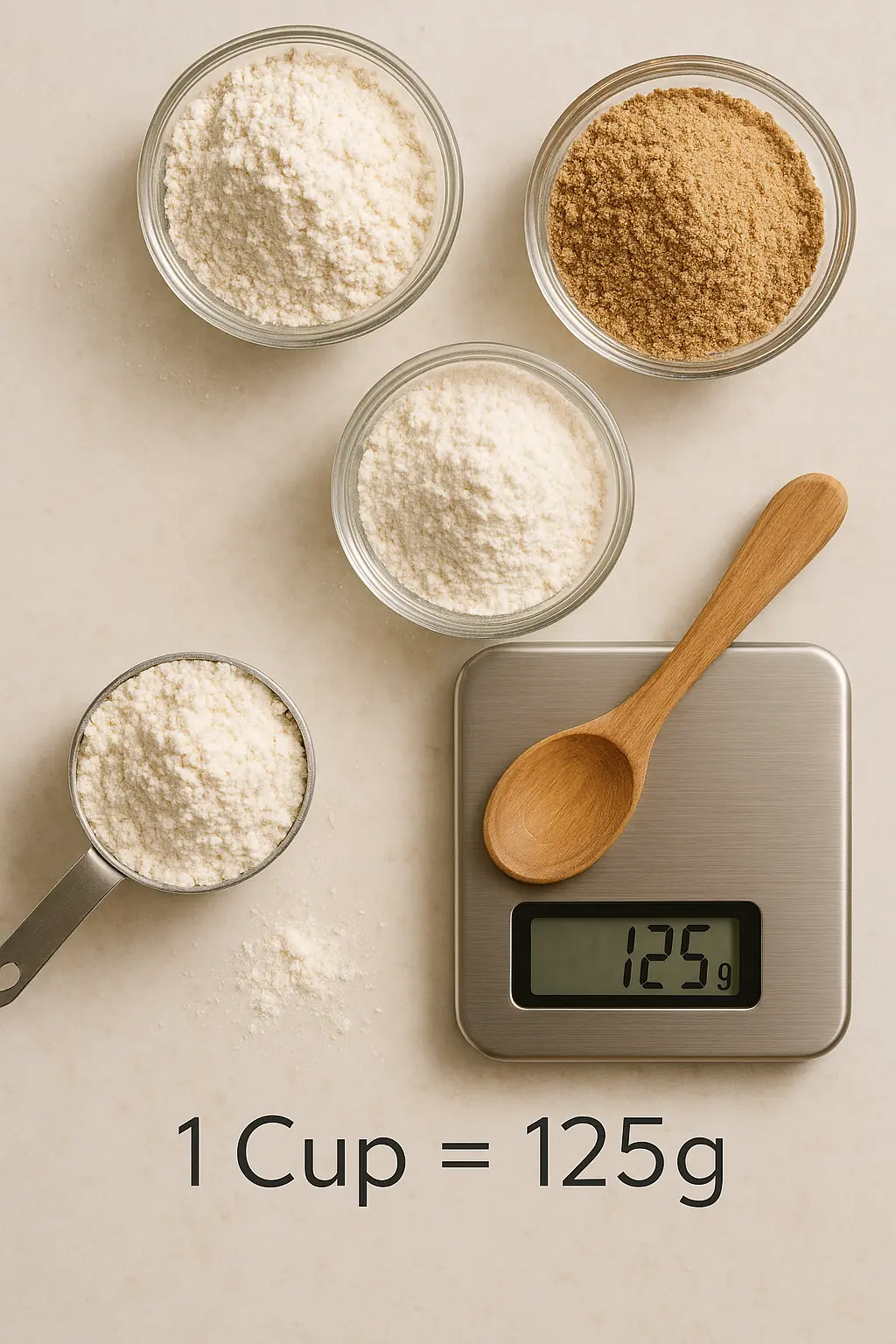
Cups to Grams Flour: The Complete Conversion Guide
Jump to Section:
Why Professional Bakers Weigh Flour (Not Measure Cups)
1 cup of flour is not a precise measurement - it's a volume that varies dramatically based on how you fill it. Meanwhile, 125 grams is always 125 grams.
- The "Flour Variation Problem": 1 cup of flour can weigh anywhere from 110g (sifted) to 160g (scooped and packed). That's a 45% difference!
- Recipe Failures: Over-measuring flour by just 20g (about 2 tablespoons extra) can make cookies dry, cakes dense, and breads tough.
- Professional Standard: Bakeries and professional kitchens use scales exclusively. Volume measurements are too inconsistent for reliable results.
- Simple Solution: A basic kitchen scale costs less than a cookbook but improves your baking more than any fancy gadget.
Try this test: Measure 1 cup of flour your usual way, weigh it, then measure another cup tomorrow. They'll likely be different weights.
Complete Cups to Grams Flour Conversion Chart
Based on analysis of USDA government data, King Arthur Baking Company standards, and professional baking organizations. These values assume the "spoon and level" measurement method.
| Flour Type | Grams per 1 Cup | Professional Source | Notes |
|---|---|---|---|
| All-purpose flour | 120–125g | USDA + King Arthur | Most common standard |
| Bread flour | 125–130g | King Arthur + AIB | Higher protein, denser |
| Cake flour | 114–115g | King Arthur + USDA | Finer, lower protein |
| Whole wheat flour | 120–125g | King Arthur + NUTTAB | Absorbs more liquid |
| Self-raising flour | 120–125g | King Arthur + AIB | Contains leavening |
| Pastry flour | 120g | King Arthur | Between AP and cake |
| flour | 125g | Italian standard | For pasta, pizza |
| Rye flour | 110–120g | USDA | Varies by grind |
| Semolina | 170g | USDA | Coarse, dense |
| Gluten-free blend | 140–150g | Manufacturer data | Check package |
Data sources: USDA FoodData Central, King Arthur Baking, AIB International. See our methodology page for complete citations.
Pro Tip: Instead of memorizing charts, use our Flour Conversion Calculator above. Select your flour type, enter cups or grams, and get instant, accurate conversions.
Understanding Flour Density Variations
Why does flour weight vary? Several factors affect density:
- Protein content: Bread flour (12-14% protein) is denser than cake flour (7-9% protein)
- Grind fineness: Finely milled flours pack more densely than coarse grinds
- Moisture content: Flour absorbs humidity from the air, gaining 5-10g per cup on humid days
- Settling: Flour settles during storage - a fresh bag vs. one stored for months differs
- Brand differences: Different mills produce slightly different particle sizes
Measurement Techniques: Why "How You Measure" Matters More Than "What You Measure"
| Measurement Method | All-Purpose Flour (g/cup) | What Happens | Accuracy |
|---|---|---|---|
|
Spoon & Level (Recommended) Fluff flour, spoon into cup, level with straight edge |
120–125g | Most consistent home method | ★★★☆☆ |
|
Dip & Sweep (Common Mistake) Dip cup into flour, sweep level |
135–150g | Packs flour, adds 15-20% extra | ★☆☆☆☆ |
|
Sifted (Then Measured) Sift flour first, then spoon into cup |
110–115g | Very light, aerated flour | ★★☆☆☆ |
|
Scooped & Packed Scoop, tap cup to settle, add more |
140–160g | Maximum packing, worst accuracy | ☆☆☆☆☆ |
|
Digital Scale (Professional) Weigh directly in mixing bowl |
Exactly 125g | Perfect accuracy every time | ★★★★★ |
The dip and sweep method adds up to 30% more flour than spoon and level. This is why two people following the same recipe can get completely different results.
How to Measure Flour Correctly (If You Must Use Cups)
- Fluff the flour: Stir flour in its container with a fork to aerate
- Use the right cup: Use dry measuring cups (not liquid cups)
- Spoon gently: Spoon flour into cup without packing or shaking
- Level properly: Use a straight edge (knife, spatula) to level off excess
- Never tap or pack: Don't tap the cup on the counter - it settles flour
Better yet: Skip cups entirely and use a scale. Place bowl on scale, tare to zero, add flour until scale reads 125g. Done.
Regional Differences: US Cups vs. Metric Cups vs. International Standards
Not all cups are equal! Different countries use different cup volumes:
| Country/Region | Cup Volume | All-Purpose Flour (g/cup) | Notes |
|---|---|---|---|
| United States (Customary) | 236.588 mL | 120–125g | Most US recipes |
| United States (Legal - FDA) | 240 mL | 120–125g | Nutrition labeling |
| Australia / New Zealand | 250 mL | 125–130g | Metric cup |
| Canada / UK | 250 mL | 125–130g | Metric cup |
| Japan | 200 mL | 110–120g | Traditional gō cup |
| Philippines | 240–250 mL | 120–125g | BFAD/BAFPS standards |
| South Africa | 250 mL | 125–130g | Metric system |
The 10mL difference between US customary (236.588mL) and metric (250mL) cups means metric recipes use about 5% more flour per cup. This small difference matters when scaling recipes.
International Recipe Conversion Tips
- Check the source: US recipe? Use 125g/cup. Australian? Use 130g/cup.
- When in doubt, weigh: Convert all ingredients to grams using our calculator
- Note the method: Some recipes specify "1 cup flour, sifted" vs. "1 cup sifted flour"
- Test small batches: When trying international recipes, make a small test batch first
Professional Baking Tips for Perfect Flour Measurements
1. The "Tare Button" Method (One-Bowl Measuring)
Professional bakers use the tare/zero button on digital scales:
- Place mixing bowl on scale
- Press "tare" (resets to 0)
- Add flour until scale reads 125g
- Press "tare" again (back to 0)
- Add next ingredient directly
Result: No measuring cups to wash, perfect accuracy, faster cleanup.
2. Flour Storage for Consistent Weight
How you store flour affects its weight:
- Airtight containers: Prevent moisture absorption (humidity adds weight)
- Cool, dark place: Prevents settling and compaction
- Fluff before use: Always stir flour before measuring to aerate
- Check freshness: Old flour absorbs more moisture
3. Converting Family Recipes to Grams
Grandma's recipe in cups? Convert it once, write it down forever:
- Use our converter for each ingredient
- Write grams next to each cup measurement
- Laminate the recipe card with both measurements
- Share with family - everyone gets consistent results
Stop Memorizing, Start Converting Accurately
You don't need to remember that 1 cup of bread flour is 130g or that 1 cup of cake flour is 115g. Our Flour Conversion Calculator has all flour types and measurement standards built in. Select any flour, choose cups or grams, and get perfect conversions instantly.
FAQs: Cups to Grams Flour Questions Answered
How many grams is 1 cup of all-purpose flour?
1 cup of all-purpose flour = 120–125 grams using the spoon and level method (USDA standard). If you scoop flour from the bag, you'll get 135–150g. For accuracy, use a digital kitchen scale and measure 125g.
What's the difference between bread flour and all-purpose flour in grams?
Bread flour is denser: 1 cup bread flour = 125–130g vs. all-purpose at 120–125g. The higher protein content and finer milling make bread flour slightly heavier per cup.
Why does sifted flour weigh less?
Sifting aerates flour, separating particles and incorporating air. 1 cup sifted all-purpose flour = 110–115g (vs. 120–125g unsifted). Always check recipe instructions: "1 cup flour, sifted" means measure then sift; "1 cup sifted flour" means sift then measure.
How do I convert cups to grams for whole wheat flour?
1 cup whole wheat flour = 120–125g (similar to all-purpose). However, whole wheat absorbs more liquid, so you may need to adjust hydration in recipes. We recommend weighing for accuracy as whole wheat varies by grind.
Are Australian cups different from US cups for flour?
Yes! Australian/metric cup = 250mL, US cup = 236.588mL. This means 1 Australian cup of flour = 125–130g vs. US 120–125g. Always check which cup standard a recipe uses.
How do I measure flour without a scale?
If you must use cups: 1) Fluff flour in container, 2) Spoon gently into measuring cup, 3) Level with straight edge, 4) Never tap or shake the cup. This gives approximately 125g for all-purpose flour. However, we strongly recommend investing in a $20 digital scale for perfect results.
Why do professional bakers use grams instead of cups?
Grams are precise, reproducible, and eliminate measurement errors. Cups can vary by 20-30% based on technique; grams are always exact. Professional kitchens use scales for consistency, quality control, and recipe scaling.
How do humidity and storage affect flour weight?
Flour absorbs moisture from air. On humid days, 1 cup can weigh 5-10g more. Store flour in airtight containers and re-fluff before measuring. This is another reason weighing is more reliable - it accounts for moisture content changes.
The Real Cost of Cup Measurements
Think "close enough" works for flour? Consider:
- Failed batches: One mis-measured cup can ruin $5-10 of ingredients
- Inconsistent results: Your signature recipe tastes different every time
- Recipe scaling problems: Doubling a cup-based recipe often fails
- Time wasted: Washing measuring cups vs. one bowl
A basic kitchen scale pays for itself in 2-3 successful batches instead of failures.
Sources & Further Learning: Conversion data from USDA FoodData Central, King Arthur Baking Company Ingredient Weight Chart, AIB International standards, and FAO/INFOODS Density Database. For technical details on flour density calculations, see our How it Works page.
From Cups to Consistent Baking Success
Knowing exactly how many grams are in 1 cup of flour transforms your baking from guesswork to precision. You're not just converting measurements; you're embracing the accuracy that separates home bakers from professionals.
Stop wondering and start weighing with confidence. Use the conversions in this guide, or let our calculator handle the complex flour database instantly.
Convert Flour NowExplore our full suite of Baking Tips to master professional techniques. Next, check out measurement accuracy techniques or learn about scaling recipes professionally.